
We build albums to outlive the people who commission them. That is the working assumption behind every board we press and every sheet we mount. But an album is only half a product when it leaves the bindery. The other half is what happens to it over the next forty years, in a house we will never see, on a shelf we did not choose.
The good news is that album care is not complicated. There is no ritual, no equipment, no annual service. There are three enemies — light, humidity and hands — and they do their damage in roughly that order of speed. Understand those three and the rest is housekeeping.
Light Is the Fastest Killer
Every printed image is a chemistry set slowly running down, and light is what winds the clock forward. Ultraviolet does the most obvious harm, which is why direct sunlight is the worst thing you can do to a print — but the unwelcome truth is that ordinary indirect daylight fades photographs too. It just takes longer. A print in a bright room with no sun falling on it is still fading; you will not notice until you compare it against a copy kept in the dark.
Fading is not even. The dyes do not surrender at the same rate, which is what makes light damage so recognisable: yellows and magentas typically go first, so a light-struck print drifts cold and blue-green as the warm channels are eaten away. Skin tones turn grey. By the time a client notices the colours look odd, a meaningful amount of dye is gone, and nothing brings it back. There is no rehydrating a faded print. It is a one-way door.
So the instruction is short. Never leave an album open on display in a window, on a sunlit console, or under a spotlight — not for a weekend, not "just while the guests are here." If a client wants a spread permanently on show, print a separate copy and treat it as consumable. The album is not a display piece; it is a container. A closed album inside its box receives almost no light at all, and it will still look correct long after the displayed one has gone pale.
A photograph on display is a photograph being spent. A photograph in a closed box is a photograph being saved. The album is not furniture — it is the vault.
The ZG Bindery Desk
Humidity and Heat
If light is the fast killer, moisture is the patient one. Paper and board are hygroscopic: they take water out of the air and give it back, changing dimension as they do it. Adhesives soften. Mould spores, already present on almost everything, sit dormant and wait for the humidity that lets them grow. The range you want is unremarkable — roughly 18–22°C and 40–55% relative humidity, more or less a comfortable living room. Staying inside the range matters as much as hitting it: a stable 60% does less damage than a room swinging between 35% and 70% every day, because it is the swing that makes boards move, warp and crack their covering.
Which is why the three places people instinctively store things are the three worst places in the house. A loft bakes in summer and freezes in winter. A basement or garage is damp, and damp above about 65% RH is where mould stops being theoretical. An exterior wall runs cold, so it is where warm indoor air condenses; an album pushed against it sits in the wettest microclimate in the room. Pull the shelf an inch off the wall and you have fixed half the problem for free.
When moisture wins it announces itself: pages that ripple and no longer sit flat (cockling), covers that bow away from the block, warped boards, prints that begin to stick to the sheet facing them, and at the ugly end, foxing and mould bloom that cannot be undone. A mouldy album is not a cleaning job. It is a conservation job, and often a loss.
Silica gel is a tool, not a cure
A few sachets tossed into a presentation box will not dehumidify a damp room. Silica gel only buffers a small, sealed volume, it saturates within weeks, and once saturated it does nothing at all. If you use it, use it inside a closed box, check it, and replace or regenerate it. Fixing the room beats fixing the box every time.

Hands, Oils and the Dinner Table
An album exists to be handled. We would rather it be opened a thousand times and show it than sit pristine and unseen. But handling is the most controllable of the three risks, and the habits that fix it cost nothing.
Human skin carries oils, salts and acids. On a print surface they are not dramatic — you will not see a mark that afternoon. What you see is the fingerprint that has quietly etched itself into the emulsion five years later, permanently, in exactly the place everyone touched. So the advice reduces to one sentence: hold the album and the sheets by their edges. Thumbs on the margin, not on faces, not on the sky, not in the middle of the spread.
Gloves, or clean hands?
Museums have moved away from cotton gloves for most photographic handling, and so have we. Gloves dull your grip and your feedback, and a dropped album or a creased sheet is a far worse outcome than a fingerprint on a margin. For everyday family use, clean, dry, freshly washed hands — no hand cream — beat gloves. Reserve gloves for bare, unprotected prints and for people already trained to use them.
And the boring one, which sounds like nagging and gets ignored for that reason: the album does not go on the dinner table. Wine, coffee, chai, cake, a toddler with sticky fingers — this is how most albums actually die. Not through slow chemical tragedy, but through one bad Sunday. Clear a dry table. Keep the drinks somewhere else.
Store It Flat, Store It Closed
A photo album is not a book and should not be stored like one. Books have thin, flexible text blocks and a spine engineered to carry their weight upright. A luxury album is the opposite: thick mounted spreads, heavy boards, a short rigid spine, a great deal of mass. Stand it on a shelf like a novel and gravity goes to work — the block bears down on the spine and hinge, the pages splay, the boards lean, and within a few years the album has a permanent sag that no re-shelving will straighten. Lay it flat and the weight spreads evenly across the whole cover. For a heavy album, flat is not a preference. It is the correct answer.
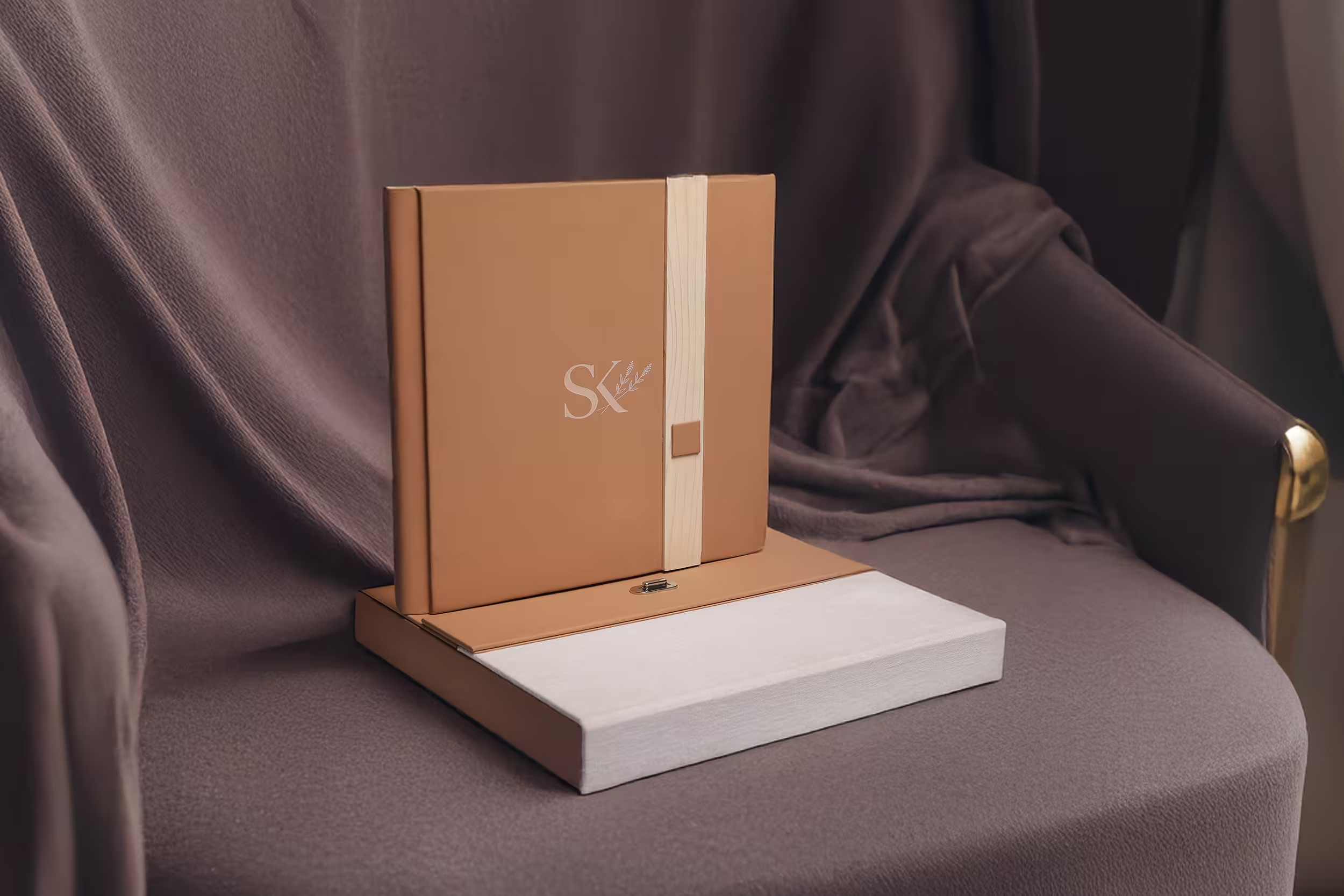
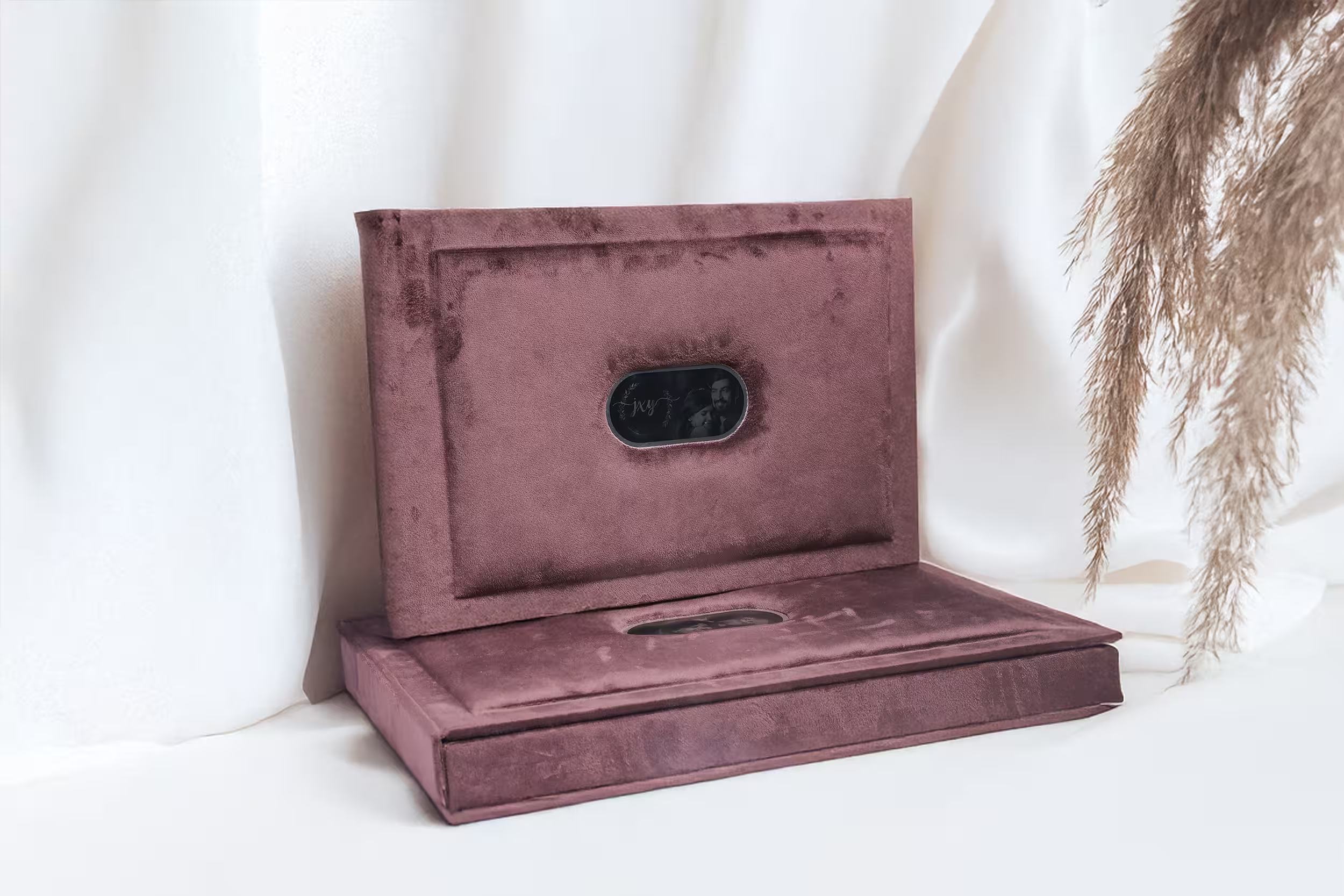
This is also the moment to say what a presentation box actually is. Clients read it as packaging — decorative, admired once, then shoved under a bed. It is not packaging. It is an archival enclosure: it blocks light almost completely, buffers humidity swings, keeps dust off the cover and supports the album on all sides. It is the cheapest and most effective conservation device your client will ever own, and it works only if the album is kept in it. Say that at delivery, out loud.
One caution: flat does not mean a tower. Two or three boxed albums are fine; a stack of eight puts sustained pressure on the one at the bottom, embossing the cover texture, crushing padded boards and pressing facing prints together. Keep stacks short, heaviest at the bottom, and never stack a bare album onto another bare album.

Cleaning: Do Almost Nothing
Almost every album we have seen ruined by cleaning was ruined by someone trying to help. The correct level of intervention, in nearly all cases, is dust removal and nothing else. A soft, clean, dry brush — wide, natural-bristle, the kind used for makeup or darkroom work — lifts dust off a cover and out of a hinge without abrading anything. A dry microfibre cloth, used gently and in one direction, does the same for a smooth cover. That is the complete toolkit, and it is never wet.
Here is what must never touch an album:
- Water. Even a "barely damp" cloth drives moisture into board and covering material, and it will cockle, stain or lift what it soaks into.
- Solvents and household cleaners. Alcohol, glass cleaner, all-purpose spray, baby wipes — they strip finishes, dissolve laminates and attack adhesives.
- Furniture polish and leather "conditioners". Bookbinding leather is not upholstery leather. Silicone polishes and consumer creams leave a residue that darkens, goes sticky and attracts dust permanently. If a leather cover looks dry, leave it alone.
- Adhesive tape of any kind, anywhere, ever — including the "temporary" repair the client swears they will remove later.
And if something has already gone wrong — mould, water damage, a torn hinge, a print stuck fast to its facing page — stop. Do not pull, do not peel, do not reach for a hairdryer. Isolate the album so mould cannot spread, keep it cool and dry, and consult a paper or photograph conservator. A conservator can often save a great deal. Nobody can save an album twice.
The Backup Nobody Makes
The most common heartbreak in this industry is not a faded album. It is a lost hard drive five years after the wedding, a dead phone, a cloud account nobody renewed, and a client who assumed — reasonably — that the photographs still existed somewhere.
The convention is the 3-2-1 rule: three copies of the files, on two different kinds of media, with one copy stored somewhere else entirely. For a family that means the working copy on the computer, a copy on an external drive, and a copy with a reputable cloud service — and then, once a year, actually opening a few files to confirm they still open. A backup nobody has ever tested is a rumour, not a backup.
Be blunt with clients about why they need both. The file is not a substitute for the album: it depends on formats, companies and passwords that outlive nothing, and it will never be picked up off a table by a grandchild who was not looking for it. The album is not a substitute for the file: it is a single physical object, and single physical objects are lost to fires, floods and house moves. The album survives the technology. The file survives the accident. Keep both.
The One-Page Care Card
All of it compresses into a short list. Print it, put it in the presentation box, and hand it over with the album — clients follow instructions they were actually given.
- Keep it out of the light. No sunlit windows, no spotlights, never displayed open.
- Keep it in a normal room. Roughly 18–22°C and 40–55% humidity. Not the loft, not the basement, not against an exterior wall.
- Clean, dry hands. Hold it by the edges. No hand cream. No gloves needed.
- No food, no drink, no exceptions.
- Store it flat, closed, and in its box. Don't stack more than two or three high.
- Dust it with a soft dry brush. Never water, never solvents, never polish.
- Back up the digital files. Three copies, two media, one off-site.
- If something goes wrong, stop and call a conservator. Do not attempt the repair.
None of this is difficult. It is a cupboard, a box, clean hands and a little restraint. Do it, and the album you delivered this year will still open properly and still hold its colour long after everyone who was in the room that day has stopped being able to remember it unaided. That is the entire point of the work.