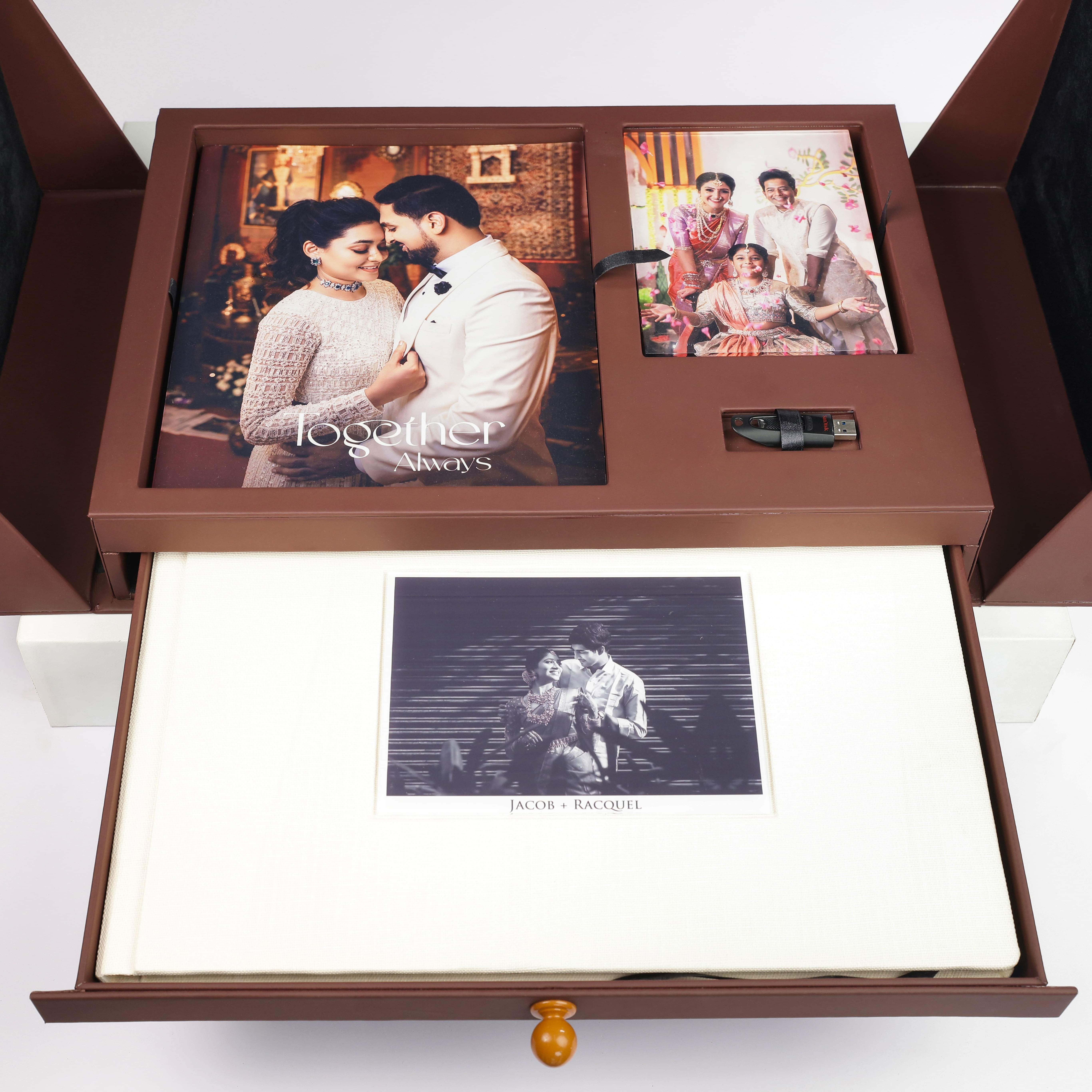
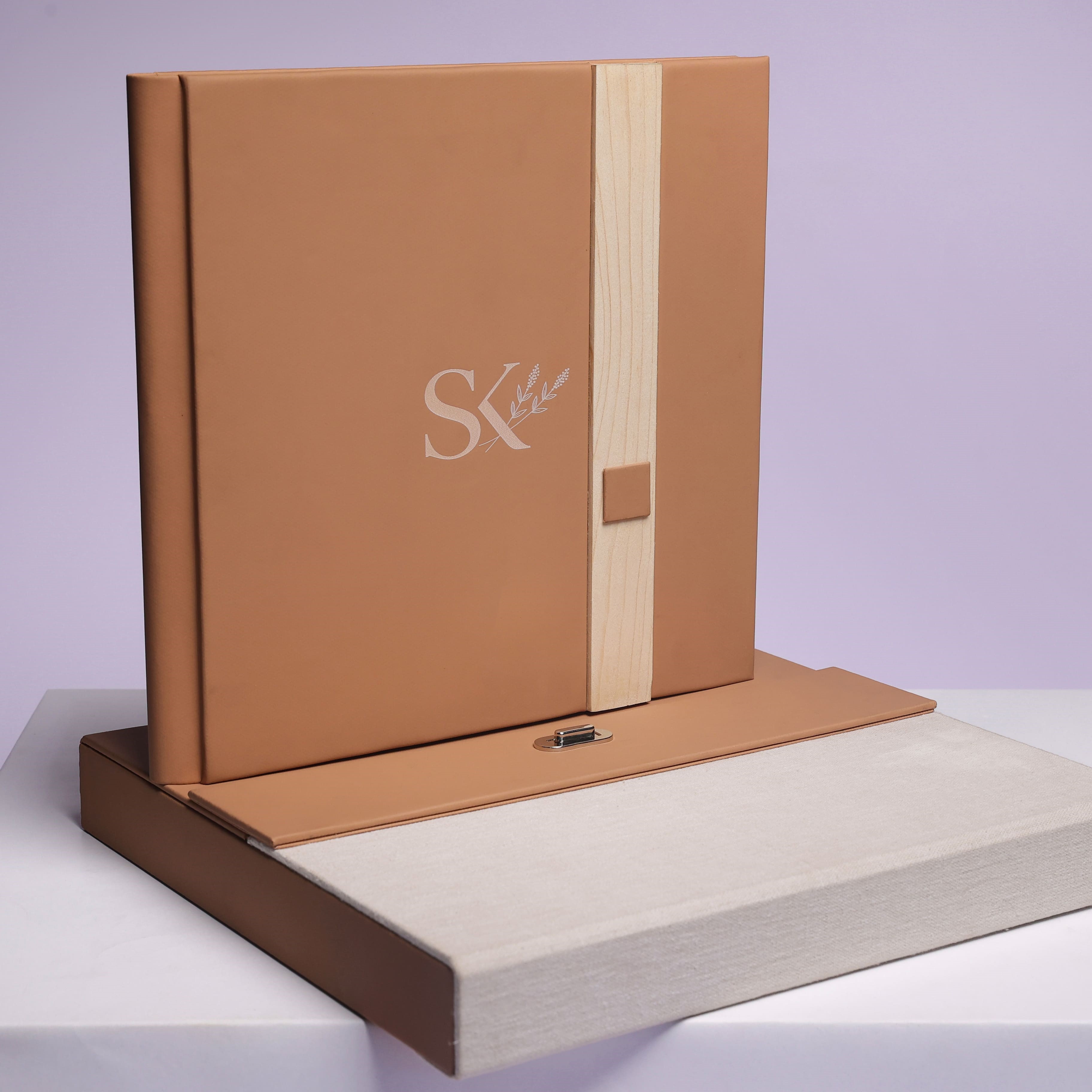
Ask a photographer which of their albums gets opened the most and they will usually say the wedding book. Ask a bindery and you get a different answer. Wedding albums are brought out for guests, admired, and put back in the box. Baby albums live on the coffee table. They get opened at two in the morning, carried from room to room, shown to grandparents, propped against a knee while the other arm holds an actual baby.
The evidence comes back to us. Wedding albums returned for repair are almost always damaged in transit. Baby albums returned for repair are damaged by use — a cracked hinge from being folded back too hard, a corner softened by a thousand thumb-presses, a page with a milk ring on it. That is not a failure of the client; it is a failure of the design. If a book is going to be handled that hard, design for the handling first and the aesthetics second. The two conflict far less often than photographers assume.
Design for One-Handed Reading
Start with weight, because weight is what decides whether an album is used or shelved. A new parent almost never has two free hands. If the book cannot be picked up, opened and turned with one hand while the other is occupied, it will be opened on the day it arrives and then quietly moved to a cupboard. We have watched this happen enough times to treat it as a rule rather than a theory.
This is why the oversized album — the 16×24 monster that looks so impressive in a studio showreel — is usually the wrong call for a newborn shoot. It is heavy, it needs a table, and it needs both arms. It photographs beautifully for your portfolio and then it never gets read. A 10×10 or 12×12 square at a modest spread count sits in a lap and lifts with one hand. Smaller is not cheaper here. Smaller is more used.
The spine matters just as much. A lay-flat binding is not a luxury upsell on a baby album; it is what stops the book being broken. When a spread refuses to open flat, someone will force it flat — pressing on the gutter with the heel of a hand, usually while holding a baby with the other. Do that fifty times and a conventional hinge gives up. A properly built lay-flat spread opens on its own weight and never invites the force that destroys it.
A baby album is not read in a gallery. It is read at 2 a.m. with one hand, in bad light, by somebody who has not slept properly in four months. Every decision you make should survive that room.
The ZG Bindery Desk
Choose Materials That Survive Real Life
The material conversation for a baby album should begin with a blunt question: what happens when something is spilled on it? Because something will be. Milk, tea, a small hand that has just been in a bowl of something. A cover that cannot be wiped clean with a damp cloth is a cover that will be permanently marked within the first year.
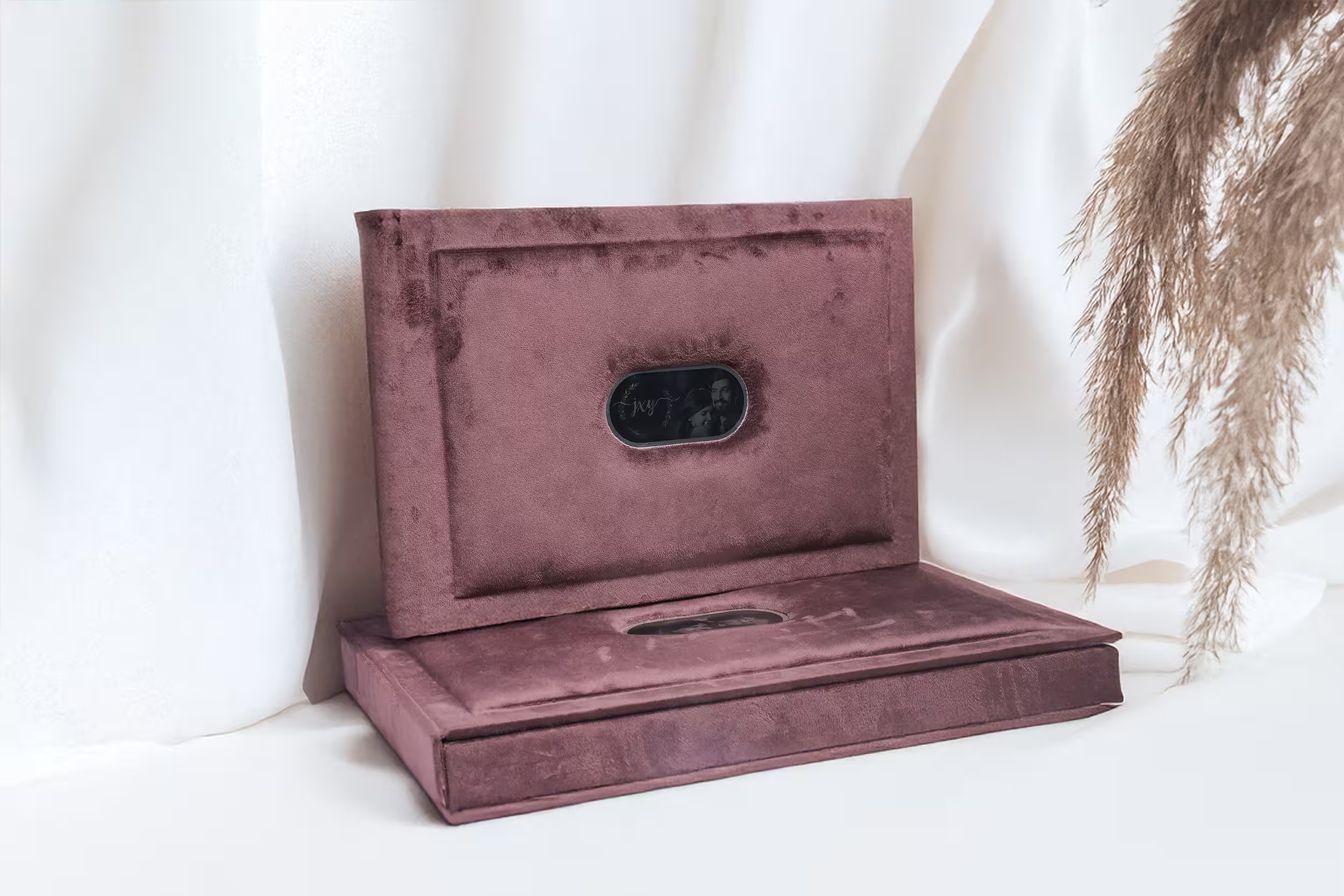
That is why we steer clients away from raw suede on baby books, even though suede is one of the loveliest things we bind in. Suede takes an oil mark and keeps it: a fingerprint darkens rather than lifts, and the surface cannot be cleaned without altering the nap. It is a wonderful choice for a wedding album that lives in a box, and the wrong choice for a book that lives beside a bottle warmer. Rexine, coated leatherette and treated leathers all take a wipe without complaint.
Pages and corners
Inside the book, lamination earns its cost quickly. A matte or lustre laminate gives you a page that resists fingerprints, tolerates a wipe, and does not lift the emulsion when it is touched with slightly damp hands. Gloss looks punchy in the showroom but shows every fingerprint and every smear — on a book handled this often, that is a slow-motion problem.
Finish with rounded corners. It is a small, cheap change that removes the sharp point otherwise pressed into a small hand, and removes the exact spot where covers dog-ear first. Square corners are the first part of a heavily-used album to look tired.
Test it the way it will be used
Before you approve a baby album spec, pick the dummy up with one hand and try to open it to the middle. If you need your second hand, the parents will need theirs too — and they do not have it.
Sequence Like a Story, Not a Catalogue
Most baby albums we receive from photographers are laid out as a portfolio: the best frames first, the strongest image on the cover spread, the rest arranged by visual strength. That is how you build a folio to win a client. It is not how you build a book someone reads for thirty years.
A baby album should run chronologically, and it should have an arc. The obvious one is hospital to home: the first hours, the leaving, the first threshold, the first bath, the first week in the room that was prepared months earlier. That arc is already inside the shoot, and following it costs nothing but the discipline to stop reordering by prettiness. A chronological book has a beginning and an end, so people finish it. A book ordered by strength front-loads, and readers drift off around spread six.
Leave room for the unglamorous frames. This is the part photographers resist hardest and the part parents thank you for. The out-of-focus shot of a father asleep in a hospital chair. The unlit corridor. The half-packed bag. The nurse's hands. These get cried over years later precisely because they are not flattering — they are true. A book of your best twenty images is a beautiful object. A book that includes the ordinary ones is a record, and a record is what was commissioned, whether or not anyone said so.
Leave White Space
The strongest instinct in album design is to fill the page, and it is almost always the wrong one. Clients pay per spread, photographers want to show the work, and a spread that could have carried one image ends up carrying five. The result reads like a contact sheet — busy, tiring, and oddly cheap-looking, however good the individual frames are.
Restraint reads as expensive. One photograph, generously margined, will hold a reader's eye longer than a mosaic of six. In a baby album this matters more than usual: the subject is small and quiet, and the register of the book is intimate. A crowded spread fights the material. A calm one supports it.
A practical target: no more than three images on any spread, and at least one full single-image spread every four or five turns. Those quiet pages act as punctuation. They give the eye somewhere to rest, and they make the busy spreads that follow feel deliberate rather than crammed.
Details That Cost Little and Mean a Lot
The finishing touches on a baby album have a strange economics: the things that cost the least in production are frequently the things clients mention first when the book arrives. It is worth knowing which ones they are.
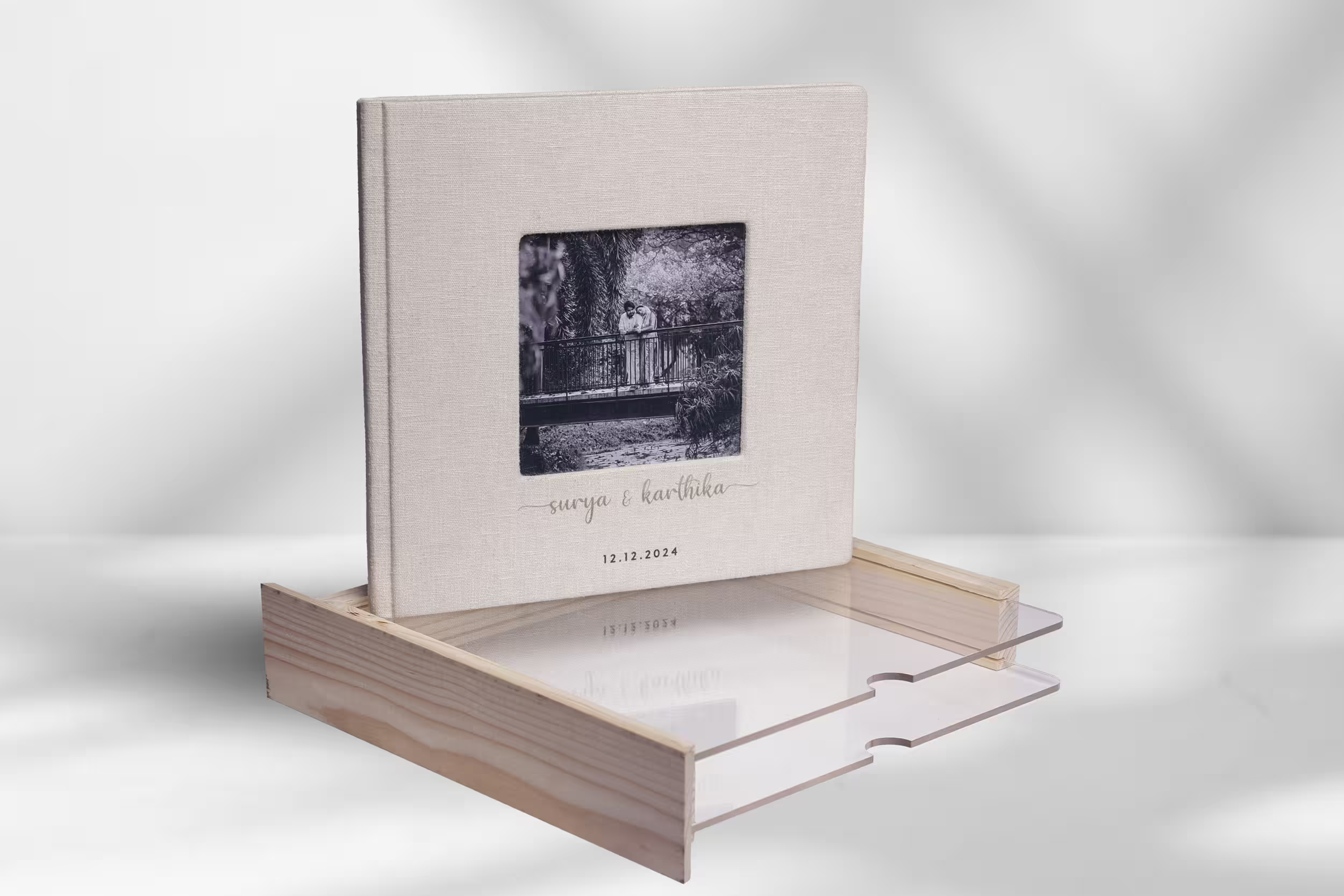
- Name and date foiling on the cover. A child's name and date of birth, blind-embossed or foiled in a quiet tone, turns a product into their book. It costs little and changes how the delivery feels.
- A birth stats page. One clean typographic spread near the front — date, time, weight, length, the hospital, the city. Fifteen minutes to set, and the page people point at years later.
- A blank end page. Leave one unprinted page at the back for a handwritten note. It is the only part of the album you did not make, and often the part they read most.
- Matching parent copies. Smaller duplicate books at a lower spread count for the grandparents. Sell them alongside the main album, not afterwards — the appetite is highest on the day the first one is opened.
A Starting Spec
If you want a default to adjust rather than a blank page, this is the spec we would build for a first-baby commission unless there is a reason not to. It is deliberately unshowy, and designed to still look good after five years of weekly handling.
- Size: 12×12 inches square (or 10×10 if the client already has a busy shelf).
- Page count: 20 to 24 spreads — enough to hold an arc, short enough to finish in one sitting.
- Cover: Wipeable coated leatherette or treated leather, with the child's name and date of birth foiled in a quiet tone. Rounded corners.
- Binding: True lay-flat, so a spread opens on its own weight and no one ever has to force the gutter.
- Lamination: Matte or lustre on every page. No gloss.
- Extras: A birth stats page near the front, one blank end page at the back.
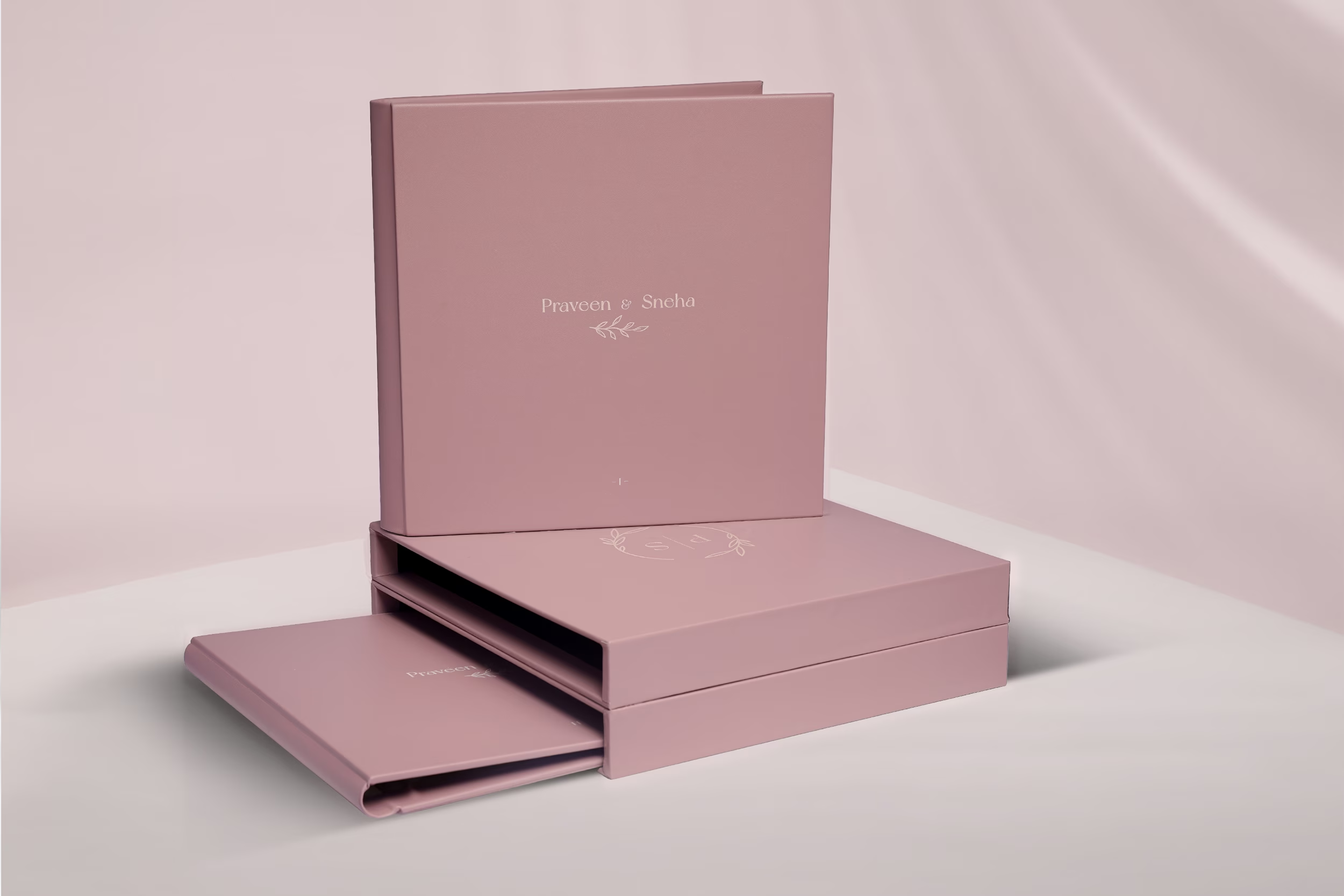
- Box: A rigid, close-fitting presentation box — used for storage between the first year and the tenth, not for the coffee table.
None of this is expensive to specify, and none of it makes the album less beautiful. It simply accepts what the book is actually for. A baby album is not a display piece that happens to be handled. It is a handled object that happens to be beautiful — and the studios who understand that difference are the ones whose albums are still on the coffee table a decade later, softened at the corners, entirely intact.